One of the most common questions I'm asked before booking a survey is: "How long will this take?" And it's a completely reasonable thing to want to know. You've had an offer accepted, your solicitor is pressing ahead, and the survey is one of the critical steps on your path to exchange. You need to know how long it will eat into your timeline.
The honest answer is that the total process — from picking up the phone to holding your completed report — typically takes between 5 and 14 working days, depending on a number of factors I'll walk you through in this guide. But the actual on-site inspection itself is often faster than buyers expect.
Stage 1: Booking the Survey
Most buyers contact us once their offer has been accepted and their solicitor has confirmed the purchase is proceeding. That's exactly the right time. In terms of turnaround, we can usually schedule an inspection within 2–5 working days of your booking, though this varies depending on:
- Time of year: Spring and autumn are typically our busiest periods, when the property market is most active. In peak periods, scheduling can take slightly longer.
- Property location: We cover Crawley and a wide area across West Sussex, Surrey, and East Sussex. Properties in our core service area are typically scheduled fastest.
- Seller access arrangements: We coordinate directly with the estate agent to arrange access. If the property is tenanted or the seller has limited availability, this can add a day or two.
When you contact us, we'll give you a clear, honest estimate of our current scheduling capacity. We don't leave clients hanging — if there's a longer wait than usual, we'll tell you upfront so you can plan accordingly.
Stage 2: The On-Site Inspection
This is the part most buyers are curious about. How long does the surveyor actually spend at the property?
The inspection time depends heavily on the type of survey and the size and complexity of the property:
Typical On-Site Inspection Times
| RICS Level 2 HomeBuyer Report — 2-bed flat or small terrace | 1.5 – 2 hours |
| RICS Level 2 HomeBuyer Report — 3-4 bed semi or detached | 2.5 – 3.5 hours |
| RICS Level 3 Full Building Survey — standard 3-4 bed property | 3.5 – 5 hours |
| RICS Level 3 Full Building Survey — large or complex property | 5 – 8 hours |
| New Build Snagging Survey — 3-4 bed house | 3 – 4 hours |
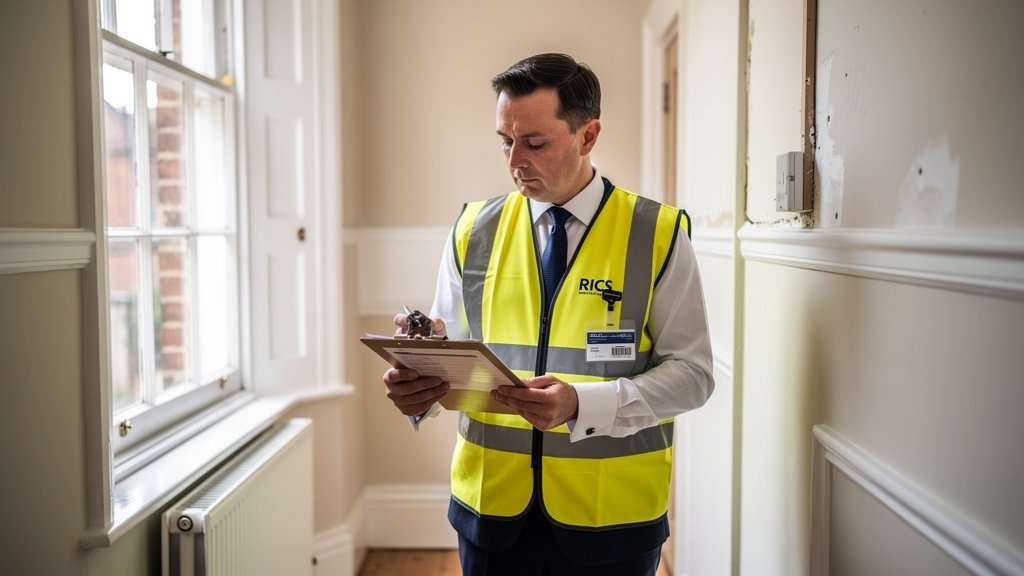
A full building survey on a large Victorian detached property with multiple outbuildings could take the best part of a working day. This isn't time-wasting — it's thoroughness. The more time I spend at the property, the more comprehensive the report will be. I inspect every accessible area: roof void, subfloor void (where present), all rooms, external envelope, drainage inspection covers, garage, outbuildings, and garden.
Do Buyers Need to Be Present?
Strictly speaking, no — we access the property through the estate agent. But I strongly recommend being available by phone during or after the inspection. If I find something significant during the survey, I'd rather speak to you that day than have you wait for the written report. And there are often questions a buyer wants to ask that are much easier to address while I'm still on-site.
Some buyers choose to meet me at the end of the inspection for a brief verbal summary. This is something we're always happy to accommodate — just let us know when you book and we can arrange a suitable time.
Stage 3: Report Writing and Review
This is often the stage buyers underestimate. Writing a thorough survey report takes significant time — often longer than the inspection itself for a detailed Level 3 report. Here's why:
- Condition ratings and commentary: Every element inspected needs to be rated, and where there are issues, the commentary needs to clearly explain what was found, what it means, and what we recommend. That takes careful, precise writing.
- Photographs: Good survey reports include annotated photographs of significant findings. Selecting, captioning and inserting these takes time.
- Cost guidance: For Level 3 surveys, we include indicative cost ranges for recommended repairs. These need to be researched and referenced to current local market rates.
- Quality review: Before a report goes to a client, it's reviewed for accuracy, completeness and clarity. We take our professional responsibility seriously.
For a HomeBuyer Report on a standard property, report writing typically takes one full working day. For a complex Level 3 survey — say, a Victorian farmhouse with multiple outbuildings and a range of defects — the report writing process can take two to three days.
Stage 4: Report Delivery
We deliver all survey reports digitally, directly to your email address. You'll receive a PDF report that you can read on any device, share with your solicitor or mortgage broker, and refer back to throughout the purchase process and beyond.
Our standard turnaround from inspection to report delivery is 3–5 working days. For particularly complex properties or during very busy periods, this can extend to 5–7 working days, but we'll always tell you upfront what to expect.
If your purchase is time-sensitive — for example, if you're approaching an exchange deadline — speak to us when you book. We can often prioritise delivery in genuine cases of urgency.
The Full Timeline: What to Expect
Typical End-to-End Timeline
What Can Affect the Timeline?
Several factors can either speed up or slow down the survey process:
Factors That Can Speed Things Up
- Good access availability from the seller or estate agent
- A straightforward standard property in good condition
- Booking during quieter periods (mid-winter tends to be less busy)
- Choosing a surveyor with local knowledge who doesn't need travel time
Factors That Can Cause Delays
- Tenanted properties where access requires tenant cooperation
- Complex or very large properties requiring extended inspection time
- Properties with significant defects requiring detailed additional commentary
- Peak market periods when surveyors are in high demand
- Additional specialist investigations (e.g., CCTV drain surveys, structural engineer visits) identified during inspection
What Happens After You Receive the Report?
Receiving the report is the beginning of the next stage, not the end of the process. Here's what typically follows:
Read it carefully — all of it. Don't just skip to the summary or the red-rated items. The full commentary for each element contains the nuance that matters. A Condition 2 item with a carefully worded commentary might be more significant than a Condition 3 with a straightforward, low-cost fix.
Call us if anything is unclear. We are always available to talk through our findings with clients. We'd rather spend 20 minutes explaining something in plain English than have you misunderstand a critical finding. This call-back service is included as standard — there's no extra charge for post-report consultations.
Use it for negotiation if appropriate. If the survey has identified significant defects, you may have grounds to renegotiate the purchase price. Our reports include indicative cost guidance for precisely this reason. Read our guide to renegotiating after a building survey for practical advice on how to do this effectively.
Share it with your solicitor. Your solicitor should be made aware of any significant findings in the survey report, particularly if they affect the legal aspects of the purchase — boundary disputes, planning compliance, building regulations sign-off for alterations, and so on.
Plan Ahead — Don't Leave It Too Late
One of the most common mistakes buyers make is leaving the survey until they feel completely certain the purchase is going ahead. I understand the logic — why spend money on a survey if the deal might fall through? — but in practice, this approach can cause unnecessary time pressure.
The survey is one of the key due-diligence steps that informs whether the deal should proceed, and on what terms. Commissioning it early gives you time to act on the findings — whether that's renegotiating the price, requesting specialist investigations, or making an informed decision to proceed with full knowledge of what you're taking on.
"Book your survey as soon as your offer is accepted and your solicitor confirms the purchase is proceeding. The timeline is manageable, but only if you start the process promptly."
If you're ready to book a survey in Crawley or anywhere across West Sussex, Surrey or East Sussex, contact our team today. We'll give you a clear quote and an honest timeline estimate within the same working day.
Frequently Asked Questions
In exceptional circumstances and for very simple properties, it may be possible to arrange a very short-notice inspection. However, report delivery will still take 3–5 working days regardless. If you have a specific deadline, contact us and we'll do our best to accommodate your timeline.
We're happy to give you a brief verbal summary of significant findings at the end of the inspection if you're present. However, we won't provide formal written findings on the day — the report writing and review process takes time and we won't compromise on quality. Everything significant will be clearly documented in your written report.
No. Post-report telephone consultations are included as standard with all our surveys. We encourage clients to read their report carefully and call us with any questions — it's part of the service, not an extra.
A survey report reflects the condition of the property at the date of inspection. There is no fixed "expiry date", but practically speaking, if several months pass between the inspection and exchange of contracts, conditions may have changed — particularly if the property has been vacant, or if the seasons have changed significantly. If there's a very long gap between inspection and exchange, it may be worth a brief follow-up visit to confirm nothing material has changed.