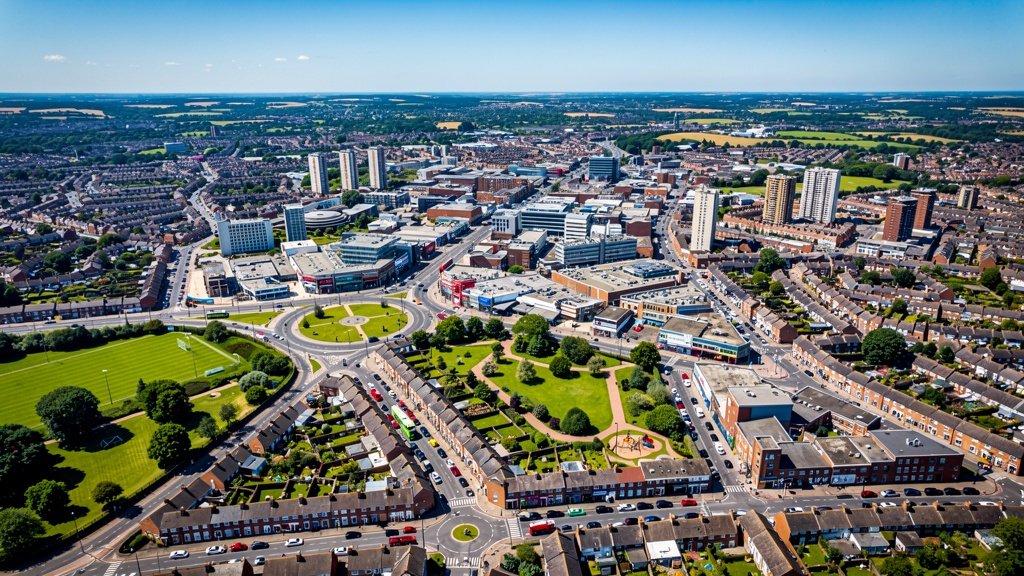
There's no better way to understand a property market than to spend time in it every week — examining properties, talking to buyers and sellers, and tracking what's happening to prices and stock levels. As surveyors working in Crawley and across West Sussex day in, day out, we have a perspective on the local market that you won't find in a national report.
Here's our honest take on the Crawley property market in 2025 — what's happening, what it means for buyers, and how to protect yourself.
Crawley: A Market in Transition
Crawley has historically been one of the more affordable options for buyers priced out of London but wanting good transport links — Gatwick Airport and direct trains to London Victoria and London Bridge have always made it attractive for commuters. That remains true, but the market has shifted significantly since the post-pandemic frenzy of 2021–22.
After years of rapid price growth, the Crawley property market has cooled to a more sustainable pace. Average house prices across the town remain broadly stable, but the days of sealed bids and properties selling £30,000 over asking within days have largely passed. This is actually good news for buyers — it means there's more room to negotiate, and it means having a solid building survey is more important than ever if you want to identify and act on genuine defects.
Understanding Crawley's Housing Stock
What makes Crawley interesting from a surveying perspective is the sheer variety of its housing stock. As a New Town designated in 1947, the bulk of Crawley's housing was built in concentrated phases, which means distinct areas of the town have very different property characteristics:
Post-War Estates (1950s–1970s)
The neighbourhoods built during Crawley's main New Town development phase — Ifield, Langley Green, West Green, Bewbush, Tilgate — contain a mixture of system-built housing types that require specialist knowledge when surveying. No-fines concrete construction, Reema properties, Airey houses and Wimpey No-Fines homes are all found in these areas. Standard mortgage lenders may have reservations about non-standard construction, and a full building survey is essential.
1980s and 1990s Developments
Areas like Maidenbower, Pound Hill and parts of Forge Wood represent Crawley's more modern housing stock — brick-built, conventional construction, generally more straightforward to survey and finance. That said, properties from this era are now 30–45 years old and increasingly showing age-related defects that buyers should be aware of.
Forge Wood
The newest major residential development in Crawley, Forge Wood has been built primarily since 2015. It represents a completely different set of surveying considerations — new-build quality issues, snagging, compliance with modern building regulations. If you're buying here, a new build snagging survey is worth considering.
What Our Surveyors Are Seeing Right Now
Over the past six months, a few patterns have emerged consistently across the surveys we've been carrying out in Crawley:
- Increasing damp issues in older properties — particularly in the post-war estates where original damp-proof courses are now 60+ years old or may never have been present. Rising damp and penetrating damp are frequent findings.
- Roof covering age — many properties in Crawley's 1960s–80s estates are reaching the end of their original roof covering's lifespan. Budget for replacement or significant repairs.
- Timber decay — older roof structures and floor joists in pre-1960 properties are showing increasing evidence of timber decay and historic beetle infestation.
- Extension quality — many properties have been extended, often without the build quality of the original construction. Lean-to extensions, conservatories and single-storey rear additions frequently show damp, inadequate insulation and drainage issues.
Using Your Survey to Negotiate
In today's more balanced market, a building survey is a genuine negotiating tool. When we identify significant defects — and we routinely do — buyers who have a clear, detailed report are in a much stronger position to negotiate a price reduction or require remediation before exchange.
In a hot market, sellers can sometimes dismiss survey findings and find another buyer. In today's market, that's much less common. We regularly see buyers use our survey findings to achieve price reductions of £5,000–£25,000 on properties in Crawley — often many times the cost of the survey itself.
Our Advice for 2025 Buyers
- Don't skip the survey — in a cooler market, sellers are more negotiable than they used to be, and a survey is your primary tool for identifying what needs doing and leveraging that in price discussions.
- Choose the right survey type — if the property is pre-1980 or has any unusual characteristics, go for a full building survey.
- Understand the local housing stock — ask your surveyor specifically about the construction type of the property you're buying. In Crawley, this matters a lot.
- Factor in repair costs early — build a realistic budget for maintenance and repairs based on your survey findings before you commit to a purchase price.
"The Crawley property market has matured. It's no longer a frenzy where you have to skip due diligence to compete. Take the time to get a proper survey — the market will support that approach."